


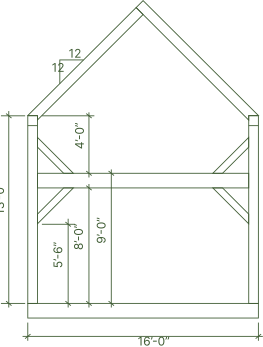
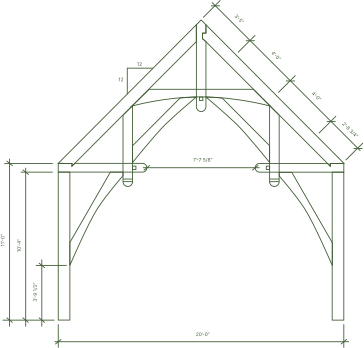

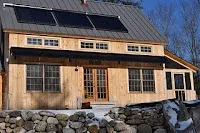
Tipton Home
Shelter has invited guest speaker, Ben Tipton, to offer a class titled, "Living More Simply" on February 18th. Ben has been featured previously on the Shelter Build blog. Four years ago, the Tipton family and Shelter built a home in Woolwich, Maine. The Tipton's goal was to downsize and live as energy efficiently as possible. You can read more about the Tipton's home and their personal journey on their blog: Simple Living.
The Tipton's home and their journey as a family to live more simply has drawn a lot of interest at Shelter. We've asked Ben to share some of his thoughts about how this journey began and what he plans on sharing at the Living More Simply class.
Shelter: Ben, please tell me how you came to live in Maine. Can you share a little bit about your family's decision to move to Maine? Was it a conscious decision to change the direction of your lives?
Ben Tipton: We made the conscious decision to simplify our lives. We were caught in the need to earn more, spend more mentality of our society and realized that it was not sustainable from a personal, family or environmental stand point. We quit a stressful job, sold our bigger house, sold or gave away things we did not need, and downsized to Maine.
S: What was the planning process like to build your home in Maine? How long did that process take?
BT: The planning was fun and stressful at the same time. The ideas were stuck in my head and needed to be expressed and that took about a year. The actual building process took about 6 months. The house was built to demonstrate that the average person can both build and afford a low impact home.
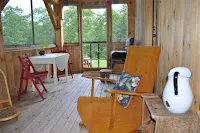
BT: The blog started after the house was finished as a way for me to get my thoughts to "paper" and keep people posted on the energy consumption. I was never that good at writing and it was also a way for me to learn more about writing (which is not one of my best skills).
I thought it would be fun way to connect and have a way for me to post my thoughts, dreams and ideas. It started as a way to post technical information, and recently I have started to transform it to a more simple living meditation.
Living is a continual experiment walking on the earth, which changes day by day. I have no idea where or how my blogging will direct my future, but I am enjoying the process.
S: What was the inspiration for offering the class?
BT: This is the first class and is a bit of an experiment. The inspiration came from the people who tour our house. Most have not only been interested in how we built our house but more so in why we built it and how we live in it. This class is an extension of the how and why we built and how we use our home to strengthen our connection to the land, family, friends, and the environment .
S: One of the key words I found interesting in a recent post on your blog is "mindfulness." Tell us a little bit about what you mean when you use that word.
BT: The word mindfulness has been around for over 3000 years and keeps making a resurgence every so often. It has many definitions but the one I like the is, "moment to moment non-judgmental compassionate awareness." It involves the idea that whenever we dwell on the past or try to predict the future we miss what is going on right now. We miss so much of the beauty around us when we fail to live in the moment. Try taking a walk with a 3 year old down a path in the woods. You will not get very far because children live in the moment. They see every little critter, vibrant color, emerging plant and stop to watch it. Us adults walk right by wondering where the path goes and how long it will take for us to get to the end of it. Returning to the moment in compassion and non-judgment starts to turn down the rambling brain, and living too much in the rambling brain mode can create stress, tension, and dis-ease.
S: What will you share with the class? What kinds of skills are most important for you to convey?
BT: I hope to share some of the thought processes as we made the decisions we did. We had to make some tough decisions when we built the house and my hope is that the path can be a little smoother for the next person. I also hope to learn as much as I teach, but the plan is have some teaching, some hands-on [learning], and some sharing. The most important skill is to just try something and see how it feels and works, then adjust. One thing we are going to do is carve a wooden spoon. I have never carved a spoon before so I picked that activity to learn with the group. Mine will most likely end up looking like a carved snake, but if it does then that it is what the wood was meant to be.
S: I have to admit that when I read your most recent blog post about attention, I was also checking email, watching my Twitter feed, and thinking about what I'll do for dinner. Do you really think attention problems are the source of our problems as a society?
BT: I have found that when my attention is mindfully focused on the present, I feel the greatest sense of peace and contentment. We know that a child will watch a grass hopper jump all the way across the lawn and on jump number 12 does the neatest back flip double twist. The adult stopped watching at jump number 2 and missed the whole show, maybe because the cell phone rang. Loss of attention is when we miss the nail and hit our finger, drive by the off ramp on the highway or burn the cookies in the oven. Mindfully regaining control of our attention is tough work, but it can be the most rewarding work we do.
In Ben's six-hour workshop he'll help you think about slowing down and enjoying every moment more fully. Come learn a new skill, explore ways you can simplify your life, connect with others and learn techniques for managing stress through simple living. We will carve a wooden spoon, make elderberry syrup, share stories, walk in the woods, and slow down while discussing ways to simplify your life while still being engaged in our modern world.
Ben Tipton has been trying to simplify his life and has been investigating the impact of simple living on our health. With over 16 years experience as a physician assistant he has seen the direct impact a stress-filled life can have and has sought ways to help heal by slowing down. His education has been supported by standing on the shoulders of really smart people, through which he has acquired many skills of yesterday and today. He currently grows his own food with the help of his wife, two kids, a dog, 8 chickens and a rabbit on the rocky clay filled soils along the coast of Maine. While he does not consider himself an expert, he employs the mindset of "try something and see what works."
Register for the Living More Simply class online at Shelter.
Tuition is $150 per person. The class will be held on the Shelter Campus, February 18, 2012 from 9:00am to 3:00pm. Lunch will be provided and each student will receive a traditional Murphy's Carving Knife and a blank of wood for carving.